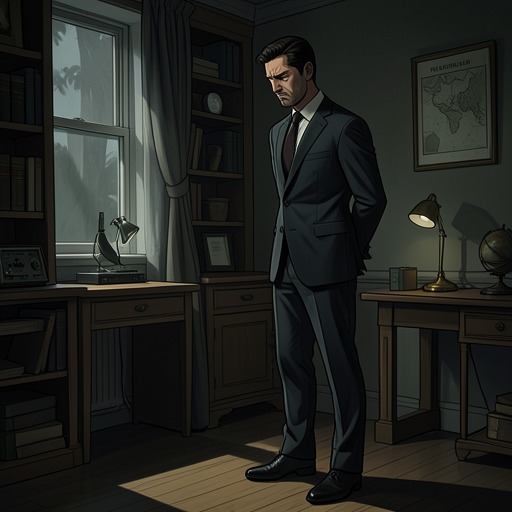
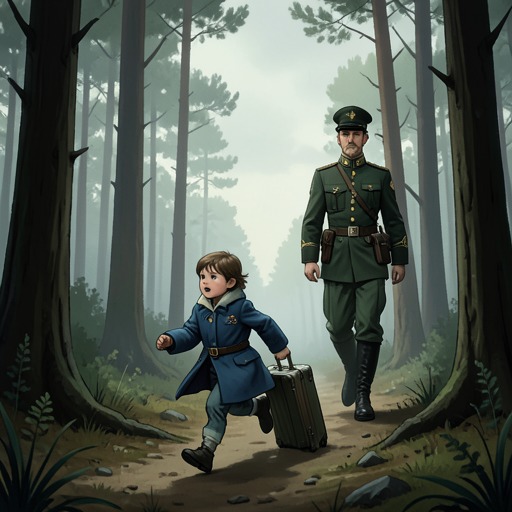
Katalin and Marika detained at Bayonne station
The Glass RoomThe detention of Katalin and Marika at Bayonne station fractures the Landauer family's flight at the moment their carefully assembled papers meet the discretion of German border officials. Although Katalin is travelling as the children's nanny and carries a Nansen passport, she and her daughter are taken away while the rest of the family is allowed to continue. Their separation shows how a border can turn a refugee document from proof of identity into a reason for scrutiny, and how little formal eligibility guarantees when officials control movement by force.
Background and Passage to Bayonne
The family is travelling through France toward Spain, uncertain about what will happen at each stage of the journey. Earlier, Rainer von Abt had remarked on the absurdity of new passport controls at a border where none had existed before. In Bayonne, that observation becomes immediate danger: the train reaches a station where German soldiers are present, and passengers are ordered off for inspection. Rumours circulate among the travellers about who may be allowed through, but no one knows what the authorities will decide.
The station inspection turns on documents, visas, tickets, and the officials’ power to decide whether those papers count. Viktor presents the family as himself, Liesel, their two children, their nanny, and the nanny’s daughter. The official examines the passports and visas, then singles out Katalin’s temporary travel document. Katalin’s Nansen passport is the only document she has, but its status does not secure her passage. The family’s collective presentation cannot prevent the official from separating her case from theirs.
Detention and Separation
When the official calls Katalin forward, Viktor identifies her as their employee and the children’s nanny. The soldier insists that Viktor has not been asked to speak. After consulting another official, the authorities take Katalin by the elbow and lead her toward a nearby hut. Marika cries out for her mother; Liesel pulls the child close and promises that she is with them and will be cared for. The official nevertheless orders that Marika go with Katalin.
The separation is carried out as a procedural matter, not explained as a finding that Katalin has committed an offence. An official describes it as a procedural issue and tells the rest of the family that they may move on. The soldier pushes Marika toward her mother, and Katalin calls Viktor as the two are taken into the hut. Their suitcases are removed from the train as well. The sequence makes the consequences of the decision concrete: mother and daughter lose not only their place among the travelling family but also their belongings and immediate freedom of movement.
Protest and Violence
Viktor argues that Katalin’s documents are in order and identifies the Nansen passport as a refugee passport. The official warns him to move back to the train unless he wishes to be detained. Viktor continues to protest that the same papers had sufficed for entry into France and should also suffice for Spain. His appeal to the documents’ previous acceptance cannot change the decision at Bayonne; legal-looking paperwork has no consistent force when each border authority can impose its own judgment.
As the family waits, Viktor returns to the platform to argue with an official. A brief confrontation follows: a soldier drives Viktor back toward the train with his rifle, and he returns to the compartment visibly shaken and bloodied. Liesel rebukes him for putting the family at risk and accuses him of valuing Katalin above his wife and children. The episode brings their private marital conflict into the open at the very moment their public security is precarious. His attempt to intervene has not released Katalin and Marika; it has instead exposed him to violence and deepened the estrangement between him and Liesel.
Departure and Significance
The family waits in the compartment while the queues continue to move through the inspection desks. Liesel holds Ottilie and Martin and tries to reassure them that misunderstandings over documents can be resolved, though she does not feel certain. The train eventually starts moving. Ottilie asks where Marika has gone, but Liesel has no answer. The family continues its journey without Katalin and Marika, while the two remain behind in custody; the episode does not establish what happens to them immediately afterward.
Bayonne makes the border more than a line crossed on a map. It is a sequence of checks, papers, official decisions, threats, and physical separation, and its power falls unevenly on travellers whose legal status is already insecure. The Landauers’ ability to continue does not mean that their party has passed intact: Katalin’s refugee status and Marika’s dependence on her become grounds for removing them from the group. The train’s departure closes the scene not with resolution, but with an absence that the family cannot explain to its children.